Showing posts with label leprechaun. Show all posts

Wednesday, November 23, 2011

leprechaun -fairy father of a great nation.

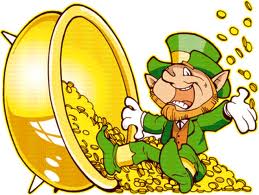
Rich lil' leprechaun swimming free in a clip art pot of gold.


A brief history....


The name leprechaun may have derived from the Irish leath brogan or shoemaker, although its origins may lie in luacharma'n Irish for pygmy.Alternative spellings in English have included lubrican, leprehaun, and lepreehawn.The leprechaun originally had a different appearance depending on where in Ireland he was found. Prior to the 20th century, it was generally held that the leprechaun wore red, not green.


The leprechaun 'family' appears split into two distinct groups - leprechaun and cluricaun. Although the leprechaun has been described as Ireland's national fairy, this name was originally only used in the north Leinster area. Variants include lurachmain, lurican, lurgadhan.


 Funny Cartoon Leprechaun playing a flute; free Saint Patrick's Day Clipart of Dancing Leprechaun playing a flute gif


If caught by a mortal, he will promise great wealth if allowed to go free. He carries two leather pouches. In one there is a silver shilling, a magical coin that returns to the purse each time it is paid out. In the other he carries a gold coin which he uses to try and bribe his way out of difficult situations. This coin usually turns to leaves or ashes once the leprechaun has parted with it.


If ever captured by a human, the Leprechaun has the magical power to grant three wishes in exchange for their release. Popular depiction shows the Leprechaun as being no taller than a small child, with a beard and hat, although they may originally have been perceived as the tallest of the mound-dwellers (the Tuatha Dé Danann).


St Patricks Day Leprechauns


Among the most popular of beliefs about leprechauns is that they are extremely wealthy and like to hide their gold in secret locations, which can only be revealed if a person were to actually capture and interrogate a leprechaun for its money. Another popular belief is that you may find a leprechaun and his pot of gold at the end of a rainbow.


Heineken Leprechaun


These apparently aged, diminutive men are frequently to be found in an intoxicated state, caused by home-brew poteen. However they never become so drunk that the hand which holds the hammer becomes unsteady and their shoemaker's work affected.


The leprechaun 'family' appears split into two distinct groups - leprechaun and cluricaun. Cluricauns may steal or borrow almost anything, creating mayhem in houses during the hours of darkness, raiding wine cellars and larders. They will also harness sheep, goats, dogs and even domestic fowl and ride them throughout the country at night. Although the leprechaun has been described as Ireland's national fairy, this name was originally only used in the north Leinster area. Variants include lurachmain, lurican,lurgadhan.
Leprechaun
This dress could vary by region, however. In McAnally's account there were differences between leprechauns or Logherymans from different regions:
  • The Northern Leprechaun or Logheryman wore a "military red coat and white breeches, with a broad-brimmed, high, pointed hat, on which he would sometimes stand upside down".
  • The Lurigadawne of Tipperary wore an "antique slashed jacket of red, with peaks all round and a jockey cap, also sporting a sword, which he uses as a magic wand".
  • The Luricawne of Kerry was a "fat, pursy little fellow whose jolly round face rivals in redness the cut-a-way jacket he wears, that always has seven rows of seven buttons in each row".
  • The Cluricawne of Monaghan wore "a swallow-tailed evening coat of red with green vest, white breeches, black stockings," shiny shoes, and a "long cone hat without a brim," sometimes used as a weapon.


Leprechauns are the owners of Shamrock and the four-leaf clover garden. In Irish tradition the Shamrock represents “the holy trinity”: one leaf for the Father, one for the Son and one for the Holy Spirit. For the four-leaf clover, it is a universally accepted symbol of good luck. One leaf is for HOPE; the second is for FAITH; the third is for LOVE; and the fourth for luck .


There is no mention of female leprechauns in traditional Irish legend, so there are different theories as to how they come about. Perhaps they are defective offspring of other fairies, or maybe they're the products of unions between fairies & humans.


glitter-leprechaun

www.leprechaunmuseum.ie/

The National Leprechaun Museum is a museum dedicated to leprechauns which has operated between Jervis Street and Middle Abbey Street (on 1 Jervis Street) in Dublin, Ireland, since 10 March 2010.


The Leprechaun is an old bachelor, who successfully resists all efforts of fairy mothers who attempt to marry him to their young, beautiful fairy daughters. This may explain why Leprechauns are always seen alone, and why there are never sightings of female Leprechauns.
So, basically, he is just like every other man...he is happy as long as he is fed, gets mad when he isn't, drinks from the milk carton, and doesn't want to get married. (I am just joking on this part)
Leprechaun Hat


Thursday, November 11, 2010

Ireland Goes On

IRELAND


The population of Ireland is approximately 6.2 million people. Just under 4.5 million live in the Republic of Ireland and just under 1.8 million live in Northern Ireland. Relatively low-lying mountains surrounding a centralplain epitomise Ireland's geography with several navigable rivers extending inland. The island has lush vegetation, a product of its mild but changeable oceanic climate, which avoids extremes in temperature. Thick woodlands covered the island until the 17th century. Today, it is the most deforested area in EuropeIreland is the third-largest island in Europe and the twentieth-largest island in the world.It lies to the north west of continental Europe and is surrounded by hundreds of islands and islets. To the east of Ireland is Great Britain, separated from it by the Irish Sea. The island is divided between the Republic of Ireland, which covers just under five-sixths of the island,and Northern Ireland, a part of the United Kingdom.


         Most of Ireland was covered with ice until the end of the last ice age over 9,000 years ago.

The Iron Age in Ireland is traditionally associated with people known as the Celts. The Celts were commonly thought to have colonised Ireland in a series of invasions between the 8th and 1st centuries BC.


The Romans would later refer to Ireland by this name too in its Latinised form, Hibernia, or Scotia.


Saint Patrick, Ireland's best known patron saint, arrived in the  year  AD 432


Saint Patrick was a Romano-Briton and Christian missionary, who is the most generally recognized patron saint of Ireland.


Saint Patrick's Day is a religious holiday on the 17th of March. 
 It began as a purely Catholic holiday and became an official feast day in the early 17th century.
 It has gradually become more of a secular celebration of Ireland's culture.


The shamrock is a symbol of Ireland. It is a three-leafed old white clover. 
The name shamrock is derived from Irish seamróg, which is the diminutive version of the Irish word for clover.


A leprechaun  is a type of fairy in Irish folklore, usually taking the form of an old man, 
clad in a red or green coat, who enjoys partaking in mischief. Like other fairy creatures, 

 The Leprechauns spend all their time busily making shoes, and store away all 
their coins in a hidden pot of gold at the end of the rainbow. If ever captured by a human, the Leprechaun has the magical power to grant three wishes in exchange for their release. Popular depiction shows the Leprechaun as being no taller than a small child.


The Irish Famine of 1740–1741 in the Kingdom of Ireland 
was perhaps of similar magnitude to the better-known Great Famine of 1845–1852. The famine of the 1840s, 
which was caused in part by a fungal infection in the potato crop resulting in a series of poor harvests.
 Hunger compounded a range of fatal diseases. In Ireland, the Great Famine was a period of mass starvation,
 disease and emigration between 1845 and 1852. It is also known, mostly outside of Ireland, 
as the Irish Potato Famine.During the Famine, Ireland's population fell by between 20 and 25 percent.
 Approximately one million people died and a million more emigrated from Ireland.


The harp has been used as a political symbol of Ireland for centuries. Its origin is from the time of Brian Boru, a famous 'High King' of the whole island of Ireland who played the harp. 


Guinness is a popular Irish dry stout that originated in the brewery of Arthur Guinness (1725–1803)
 at St. James's Gate, Dublin. Guinness is directly descended from the porter style that originated in London 
in the early 18th century and is one of the most successful beer brands worldwide. A distinctive feature is 
the burnt flavour which is derived from the use of roasted unmalted barley.


Dublin  is the primate and capital city of Ireland.
 It is officially known in Irish as Baile Átha Cliath .
 The English name is derived from the Irish Dubh Linn (meaning "black pool"). 
The city has an urban population of over 1 million people and is located near the midpoint of Ireland's east coast,
 at the mouth of the River Liffey and at the centre of the Dublin Region.


The Cliffs of Moher are located in the parish of Liscannor at the south-western edge of the Burren area near
 Doolin, which is located in County Clare, Ireland.The Cliffs of Moher rank as one of the most popular tourist destinations in Ireland and topped the list of attractions in 2006 by drawing almost one million visitors.


The Dingle Peninsula  is the northernmost of the major peninsulas in County Kerry. 
Its ends beyond the town of Dingle at Dunmore Head, the westernmost point of Ireland.


"Molly Malone" (also known as "Cockles and Mussels" or "In Dublin's Fair City") is a popular song, set in Dublin, Ireland,
 which has become the unofficial anthem of Dublin City.


The Spire of Dublin, officially titled the Monument of Light is a large, stainless steel,
 pin-like monument 121.2 metres (398 ft) in height, located on the site of the former Nelson's Pillar on O'Connell Street 
in Dublin.


The Liffey (An Life in Irish) is a river in Ireland, which flows through the centre of Dublin.

Aer Lingus (ISEQ: EIL1, LSE: AERL) (a phonetic rendering of the Irish Aer-Loingeas, "air fleet") is the flag carrier of Ireland

Hurling  is an outdoor team sport of ancient Gaelic origin, administered by the Gaelic
 Athletic Association, and played with sticks called hurleys and a ball called a sliotar. 
The game, played primarily in Ireland, has prehistoric origins and is thought to be the world's 
fastest field team sport in terms of game play.

Irish (Gaeilge) is a Goidelic language of the Indo-European language family, originating in Ireland and
 historically spoken by the Irish people.

The euro (sign: €; code: EUR) is the official currency of the eurozone:
 16 of the 27 Member States of the European Union (EU) including ireland. 


The coins are issued in €2, €1, 50c, 20c, 10c, 5c, 2c, and 1c denominations.  

Notes are issued in €500, €200, €100, €50, €20, €10, €5.

Garda Síochána na hÉireann  Irish for "Guard(ians) of the Peace of Ireland"), more commonly 
referred to as the Gardaí, is the police force of the Republic of Ireland.